
Air Duct Cleaning: Repair or Replace? How Madison Homeowners Decide
Most homeowners in Madison decide whether to repair or replace ductwork based on how the ducts look through the supply registers. That’s the wrong evidence. Ducts that look intact from the grille can be leaking badly at every joint, and ducts that look grimy can be structurally sound. The repair-versus-replace question is answered by a pressure test and a camera, not by cleaning results. Here’s how to run that decision properly.
Cleaning deteriorated flex duct is like detailing a car with a blown engine. The work is real, but the underlying problem makes the investment moot until the structure is fixed first. If you’d rather have a technician run the diagnostic than rent a blower door yourself, call (844) 443-4890.
Why a Leakage Test Comes Before Any Cleaning Decision
A duct leakage test measures how much conditioned air your system is losing before anyone cleans or repairs anything. This is the step most Madison homeowners skip, and it’s the one that changes the answer. Without a number, every repair-or-replace recommendation is a guess dressed up as expertise.
The test itself involves sealing the registers, pressurizing the duct system with a calibrated fan, and measuring how much air escapes. A duct blaster measures duct leakage directly. A blower door measures whole-house leakage and can be combined with a duct blaster to isolate the ducts. Either way, you end up with a percentage of system airflow lost to leaks.
That number does three things:
- It tells you whether leaks are worth repairing or whether the whole system is beyond saving.
- It gives you a baseline to compare against after repair, so you know the work actually helped.
- It converts an abstract “your ducts are leaky” into a measurable loss you can weigh against replacement cost.
In our experience, this is the single biggest gap between a contractor who is diagnosing and one who is selling. If a Madison company recommends full replacement without a leakage number, ask for one or get a second opinion. The same discipline applies to HVAC cleaning, where hidden leaks into cabinet panels often masquerade as duct problems.
Duct Lifespan Benchmarks in Middle Tennessee’s Climate
Middle Tennessee’s humid summers and cold snaps stress duct materials in specific ways, and each material fails differently. Knowing the typical lifespan and failure pattern for your duct type is the second input in the repair-or-replace decision.
Flex duct
Flex duct typically lasts around 10 to 15 years in a humid climate. It fails by sagging, by the inner liner collapsing, and by tearing at the connections. It’s also the material most sensitive to poor installation, since sharp bends and unsealed collars kill airflow fast. When flex fails, repair usually means replacing the run, not patching it.
Fiberglass duct board
Duct board can last 15 to 25 years if it stays dry. In Middle Tennessee humidity, the enemy is moisture. Once the board absorbs water, it breaks down, loses its insulation value, and can become a growth surface. Visible sagging, soft spots, or crumbling edges mean the section is done. Small sections can sometimes be rebuilt, but wet duct board usually comes out.
Sheet metal
Galvanized sheet metal is the longest-lived option, often 20 to 30 years or more, and it holds up well to this climate. It fails at the seams and joints, where sealant dries out and separates. That’s actually good news, because sheet metal is the most repairable material. Sealing joints and re-insulating the exterior is a legitimate fix that adds years of service.
If you’re unsure which material runs through your Madison home, a camera inspection settles it quickly. The material matters as much as the condition.
What Camera Inspection Shows That a Register Check Misses
A camera inspection reveals the interior condition of the duct run, which is exactly the part no register check can reach. Looking into a supply grille from inside the room tells you almost nothing. Pushing a camera through the trunk line tells you what you’re actually dealing with.
Here’s what a camera pass typically reveals:
- Disconnected joints where two duct sections separated years ago and are blowing air into a wall cavity.
- Torn inner liners in flex duct, where the plastic membrane has peeled away and fiberglass is exposed to airflow.
- Crushed sections from someone stepping on flex in the attic or a joist pinching a run.
- Moisture and staining that signals a leak from a roof or plumbing issue above the duct.
- Debris and pest evidence that a shop-vac approach would stir up rather than remove.
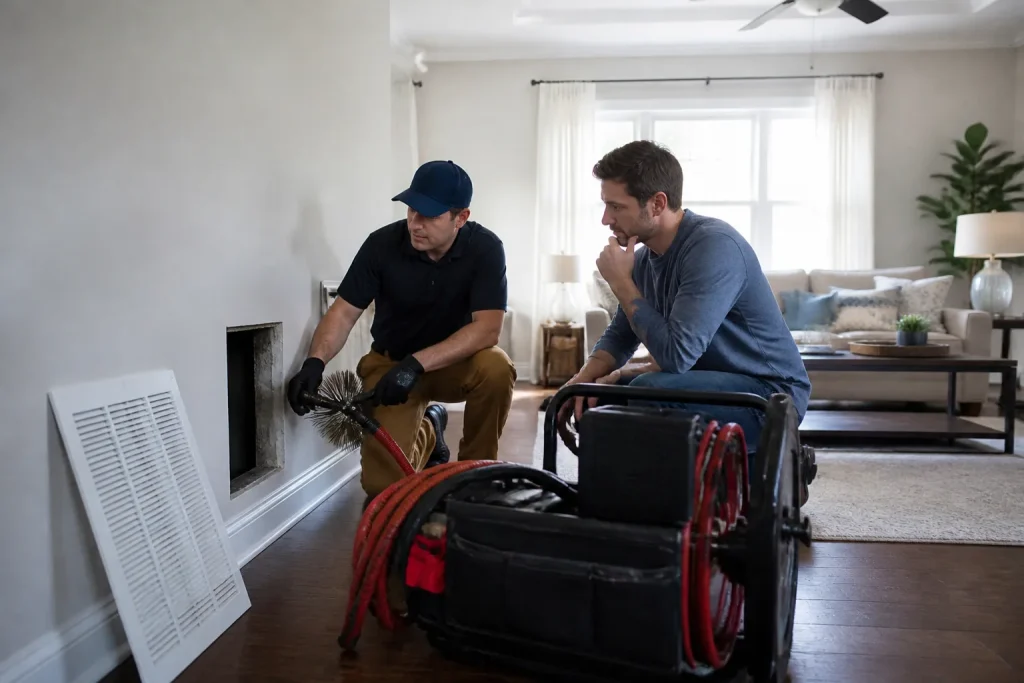
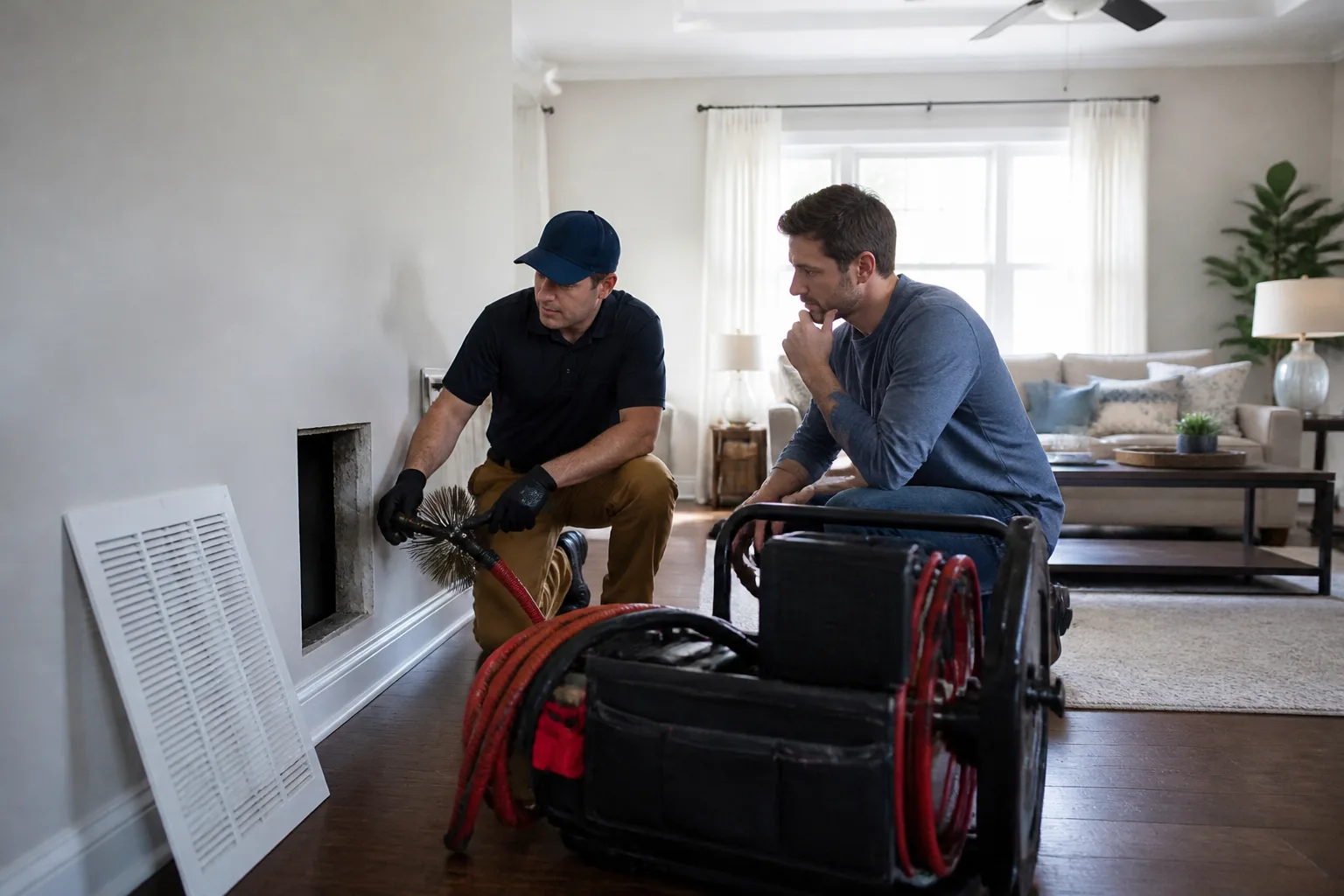
We run Rotobrush rotary-brush equipment through the system and pair it with Nikro HEPA-class negative-pressure containment so this inspection process doesn’t blow the evidence into your living room. The point isn’t the brand names; it’s that camera inspection plus pressure testing produces a factual condition report you can act on. A Madison homeowner should be able to see the footage and understand what they’re looking at.
Partial Repair Plus Cleaning vs. Full Replacement
Partial repair plus cleaning is the right answer when the duct structure is fundamentally sound but leaks are costing you efficiency. Full replacement is the right answer when the material itself has failed broadly. The way to tell the difference is arithmetic, not a gut feeling.
Here’s the calculation method:
- Get the duct leakage percentage from the pressure test.
- Estimate how much of that leakage a targeted repair (sealing joints, replacing a specific run, reconnecting a separated section) would recover.
- Compare the annual energy cost of that recovered loss against the cost of the repair.
- Divide the repair cost by the annual savings to get the payback period.
That’s the energy payback calculation. If the repair pays itself back in a reasonable number of years and the material has life left in it, repair plus cleaning is the smarter spend. If the ducts are near the end of their expected lifespan, or the failure is widespread across many runs, replacement is the honest recommendation even though it’s a bigger number.
In our experience, the middle case is common in Madison: sheet metal trunk lines in good shape with a few failing flex branches. That’s a repair job, not a replace job. We handle duct repair and sealing in-house, so a repair scope doesn’t get referred out to a subcontractor who may not show up for weeks. For the cleaning side, see air duct cleaning. We also see return-side problems get blamed on supply ducts, which is a conversation worth having with dryer vent cleaning in the same visit for the utility side of the system.
Getting a Repair Scope That’s Specific
A specific repair scope names the sections, quantifies the leaks, and shows you the camera footage. A vague recommendation to “replace everything” is a sales decision, not a diagnostic one. Learning how to ask for the right thing is worth more than any single piece of equipment.
When you talk to a contractor in Madison, ask these questions directly:
- Which runs failed inspection, and can I see the footage?
- What was the measured leakage before and what will it be after?
- What material is each failing section, and how much life does it have left?
- Is the repair sealed and tested at the end, or just patched?
- Does the recommendation cover supply and return, or only one side?
A contractor who can answer these with specifics is working from data. One who can’t is guessing. That’s the filter we’d want you to apply to us too.
When to Call a Pro
Call a professional when you have any of the following: visible sagging ducts in the attic, a pressure test showing meaningful leakage, musty odors near registers, or a camera inspection that’s more than you want to manage. Duct work involves opening the air pathway, sealing joints correctly, and confirming with a retest, and getting that wrong can make efficiency worse. If your system includes a dryer vent, that’s a separate concern worth a call as well.
Related Services in Madison
If the diagnostic points to a broader air-quality conversation, we also handle sanitizing treatments and integrate Honeywell and Aprilaire products for long-term improvement. Guardsman chemicals are available for the sanitizing stage that follows cleaning, never replaces it. For a full-system view, start at Madison Air Duct Cleaning Co and we’ll walk through what your specific ducts need.
What happens when you call
- 1
A real person answersNo phone trees – you reach a local pro.
- 2
You get an upfront price rangeHonest numbers before anyone is dispatched.
- 3
A background-checked tech heads outLicensed & insured, dispatched right away.
- 4
You approve before work beginsNothing starts until you say go.
The Bottom Line
The repair-or-replace decision for ductwork in Madison comes down to two things a camera and a leakage test give you honestly: the condition of the material and the measured cost of the leaks. Cleaning alone doesn’t fix structural problems and doesn’t tell you whether they exist. Get the diagnostic first, then let the payback arithmetic drive the decision. Partial repair plus cleaning wins when structure is sound; full replacement wins when material has broadly failed.
Our technicians have up to 15 years of experience with this kind of inspection. If you’re in Madison and want a free estimate with the diagnostic done properly, Madison Air Duct Cleaning Co can help. We answer 24/7. Fast dispatch from 7am to 7pm, Sunday through Friday. Call (844) 443-4890.
Frequently Asked Questions
Pricing is set per job by a free written estimate, and it depends on system size, duct material, accessibility, and whether repair or sealing is needed. We quote the whole system as one flat price before work starts rather than pricing per vent. Call (844) 443-4890 for an exact quote; estimates are free.
How do I know the work was actually done?
You should get before-and-after camera footage of your own ducts, plus a leakage retest showing the improvement. Those two pieces of evidence separate a real job from a receipt. If a company won’t provide them, that’s your answer. Call (844) 443-4890 for a scope that includes the evidence.
Most homes in Madison don’t need duct cleaning on a fixed schedule. The better trigger is a diagnostic: a leakage test and camera inspection every few years, or after a renovation, pest issue, or moisture event. Clean when the inspection says so, not on a calendar. Call (844) 443-4890 to schedule the inspection that answers it.
Written by the team at Madison Air Duct Cleaning Co.
Need Air Duct Cleaning Help?
Call Madison Air Duct Cleaning Co - the local pro we connect you with is licensed and insured, with free written estimates in Madison.
(844) 443-4890