
Nikro Air Duct Cleaning in Madison: A Homeowner’s Guide
Two companies can both advertise “professional duct cleaning.” One runs a Nikro negative-air machine pulling thousands of cubic feet per minute and trapping what it disturbs. The other drags a shop vac in from the truck, swaps a branded sticker onto it, and calls it a day. The work is not comparable, and neither is the result. If you’ve been comparing quotes in Madison and wondering why the numbers land so far apart, the equipment is usually the reason. Here’s what Nikro actually does, in plain terms.
If you’d rather have someone walk you through it than read a guide, call (844) 443-4890. We’re glad to explain what a proper job looks like before anyone touches your system.
What Is Nikro Air Duct Cleaning, Exactly?
A Nikro cleaning is a negative-pressure cleaning: a HEPA-class vacuum unit is connected to your duct system and held under vacuum while the ductwork is agitated from the inside. The vacuum creates a pressure difference so that loosened debris travels toward the collection unit instead of drifting into your living room. That’s the whole idea in one sentence. Everything else is engineering detail about how well the unit holds that pressure and how completely the debris is captured.
The “Nikro” part isn’t a marketing label. Nikro makes the HEPA-class vacuum units and containment equipment that commercial and industrial contractors use when they can’t afford to release dust into an occupied space. When a residential crew brings that class of machine into a Madison home, the practical difference shows up at the registers, in the return air, and in how much material ends up in the collection bag versus on your furniture.
It’s worth being clear about what Nikro is and isn’t. It’s the containment and extraction side of the job. It doesn’t agitate duct walls by itself, and it doesn’t seal leaks. That’s why serious contractors pair it with the right tools for the debris they find.
Why the CFM Rating Matters More Than the Brand Name
CFM stands for cubic feet per minute, and it’s the number that tells you how much air the machine can move while it’s working against the resistance of your ductwork. A higher CFM rating means the system can hold negative pressure across a longer run of duct, which matters in a house with a sprawling layout and several branches off the main trunk. A unit that pulls plenty of air in a short, straight run can lose its grip once the path gets long and narrow.
Here’s the part most homeowners never hear: a vacuum’s advertised CFM is measured under ideal conditions. Real ductwork adds resistance. Length, elbows, flex duct, and accumulated debris all reduce the airflow the system actually delivers to the far end of a run. That’s why the honest question isn’t “what’s the CFM?” but “what CFM can this unit hold at the farthest register in my house?” A technician who can answer that is thinking about your ductwork, not the brochure.
- Short, simple runs: almost any decent unit can maintain pressure.
- Long runs with multiple branches: pressure drops fast, and a weak unit loses containment.
- Flex duct and tight turns: resistance climbs, and so does the need for a stronger vacuum source.
- Multiple returns or a second system: each air path needs to be addressed, not just the main trunk.
In Madison, where a lot of homes have a mix of original ductwork and later additions, that last point matters. One machine connected to one trunk line doesn’t necessarily clean the whole system.
Contact Vacuuming vs. True Negative-Air Cleaning
These are two different jobs, and confusing them is the most common way homeowners get a disappointing result. Contact vacuuming means a technician reaches into the duct with a hose or brush and vacuums what’s within reach. It works on accessible surfaces and it’s useful in tight spots where a full negative-air setup is impractical. What it cannot do is clean the whole interior of a long duct run from one opening, because the vacuum never gets close to most of the surface.
True negative-air cleaning reverses the relationship. Instead of chasing debris with a hose, the system is put under vacuum and the debris is drawn toward the collection unit while agitation tools break it loose. Every branch of the system gets the same treatment, and the vacuum is doing the moving, not the technician’s arm.
Both approaches have a place. Contact vacuuming is often the right call for a short, easily reached section or a surface that can’t take agitation. Negative-air cleaning is the standard for a full-system job. When a crew tells you they’re cleaning “the whole system,” ask which method they mean. If the answer is contact vacuuming only, you’re getting a surface pass.
When the work is done properly, it covers the whole pathway. That’s why our air duct cleaning starts by tracing the system from the return grille to the blower unit, so nothing gets skipped.
What Nikro Equipment Cannot Do
This is where a lot of marketing gets slippery, so we’ll be direct: a negative-air machine removes loose and lightly adhered debris. It does not scrub a duct wall clean on its own. Fibrous material like pet hair, lint, and matted dust binds to duct surfaces and has to be broken loose by mechanical agitation before the vacuum can capture it. That’s the job of a rotary-brush tool.
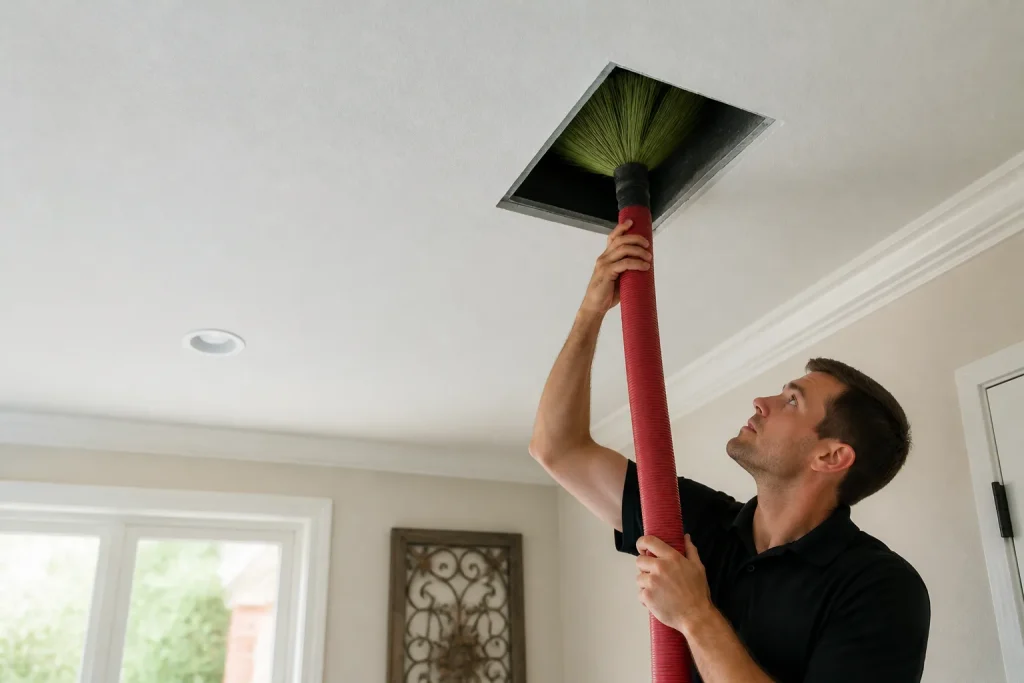
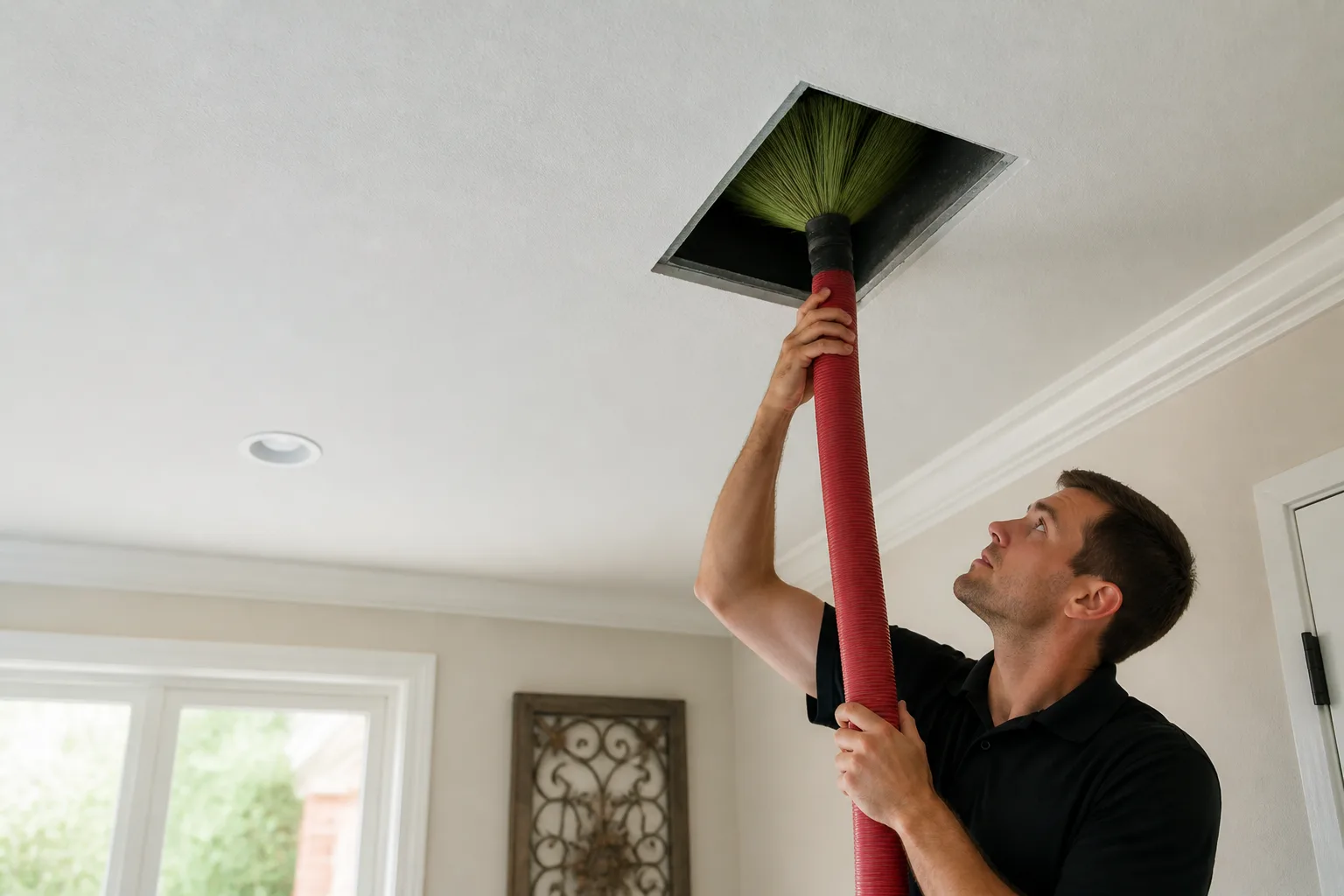
Which is why a professional setup pairs them. Rotobrush rotary-brush systems do the dislodging; the Nikro HEPA-class unit does the containing and extracting. One without the other is half a process. A truck full of vacuum equipment and no agitation tools will leave fibrous debris right where it was, and a brush with no real vacuum behind it just throws that debris into the air.
There’s a third piece too. When debris gets disturbed, airborne particulates spike in the work area. That’s why we deploy Abatement Technologies air filtration on-site during the job, capturing particles in real time instead of letting them settle back into the house. Cleaning one part of the system while contaminating another isn’t cleaning.
And when a cleaning turns up loose joints, gaps, or damaged duct sections, that’s a repair conversation, not a cleaning one. We handle duct repair and sealing in-house, so a problem found during the job gets addressed rather than referred out.
Portable or Truck-Mounted? The Question to Ask
Ask any contractor whether they’re bringing a truck-mounted Nikro unit or a portable one. Both are legitimate. The answer tells you how the job will actually run, and it should match the size and layout of your home.
- Truck-mounted units generally deliver more sustained vacuum and hold pressure over longer runs, which suits larger homes and commercial spaces with long duct paths.
- Portable units are more flexible in tight access situations and can be positioned close to the work, but they need to be sized correctly for the job or containment suffers.
- Either way, the machine should be set up before any agitation begins. Cleaning first and vacuuming later is backwards.
A crew that can explain which setup they’re using and why it fits your house is a crew that has thought about your system. A crew that can’t answer at all is telling you something too. For property managers in Madison coordinating work across multiple units, that answer also affects scheduling and how many systems can realistically be handled in a visit.
How to Verify the Job Was Actually Done
You don’t need to crawl through the attic to check the work. You need to look at a few specific things after the crew finishes, and you need before-and-after photos of your own ducts, not stock images from a brochure.
- Look at the register grilles. They should be clean, wiped down, and free of the dust line that was there before. A “cleaned” system with dusty grilles is a red flag.
- Check the return air grille and the filter slot. The area around the filter should show no loose debris, and the filter should be seated properly.
- Ask about the collection bag. A proper negative-air job produces a bag of material, and a technician should be able to show you what came out.
- Listen to the system after it runs. Airflow at the registers should be even, and the blower should sound like it did before, or quieter if the system was restricted.
- Request before-and-after photos. If a company can’t provide them for your home, ask why.
One more thing to understand about Madison homes specifically: our humid summers and cool, damp stretches mean ductwork can hold moisture, and moisture turns dust into something that clings. That’s a reason to pair cleaning with a sanitizing treatment that follows the cleaning, not replaces it. Cleaning first, sanitizing after, is the order that works.
When to Call a Pro
Some duct problems are cosmetic. Others aren’t. Call a professional if you notice any of the following:
- Visible dust or debris blowing from the registers when the system starts.
- Persistent musty or stale odors that don’t clear after a filter change.
- Uneven airflow between rooms, or rooms that never seem to get enough air.
- Visible gaps or disconnected sections in accessible ductwork.
- A dryer that takes much longer than it used to, which points to dryer vent cleaning.
- Debris around the blower or the indoor coil, which calls for HVAC cleaning rather than duct cleaning alone.
If you’re not sure which of these applies, describe what you’re seeing and we’ll tell you what the work likely involves. Cleaning and sanitizing are the start, not the whole picture: we also integrate Honeywell and Aprilaire air-quality products when a home needs ongoing filtration rather than a one-time reset.
The Bottom Line
Nikro matters because it’s a real engineering choice about pressure and containment, not a badge on a truck. If you take one thing from this guide, make it the question you ask: “What equipment are you bringing, and how does it hold negative pressure across my whole system?” A clear answer tells you the crew understands the work. A vague one tells you just as much.
Key takeaways:
- Negative-air cleaning and contact vacuuming are different jobs. Full-system work needs the first.
- CFM rating is a machine’s capacity under ideal conditions. The real question is pressure at the farthest register.
- Nikro handles containment and extraction. Rotobrush handles agitation. You want both.
- Abatement Technologies air filtration keeps dislodged particles out of your living space during the job.
- Ask for before-and-after photos of your own ducts, and look at the registers before the crew leaves.
If you’re in Madison and need help, Madison Air Duct Cleaning Co offers free estimates. Call (844) 443-4890. We answer 24/7, and fast dispatch runs from 7am to 7pm, Sunday through Friday.
For the full picture of what we cover across the whole air pathway, start with Madison Air Duct Cleaning Co. Our technicians have up to 15 years of experience with this equipment, and we’re happy to walk you through the process before you commit to anything.
Frequently Asked Questions
The cost depends on system size, how many branches and returns need cleaning, and what condition the ductwork is in. We don’t quote a number before we’ve seen the system, because a per-vent price tells you nothing about the actual scope. The estimate is free and the price is set per job by the written estimate, agreed before work begins. Call (844) 443-4890 for an exact quote; estimates are free.
Usually because the job is smaller than it appears: contact vacuuming instead of negative-air cleaning, a shop vacuum instead of a HEPA-class unit, or one trunk line cleaned and the rest of the system skipped. The equipment is the difference, and it’s why two quotes can look like different services entirely. Call (844) 443-4890 for an exact quote; estimates are free.
Look at the register grilles and the return air filter slot, ask to see the collection bag, and request before-and-after photos of your own ducts rather than stock images. A crew that did the work will have no trouble showing it. Call (844) 443-4890 for an exact quote; estimates are free.
There’s no single schedule that fits every home. Visible debris at the registers, musty odors, uneven airflow, recent renovation work, or a system that hasn’t been serviced in a long while are all reasons to have it looked at. We’ll tell you honestly whether it needs doing now. Call (844) 443-4890 for an exact quote; estimates are free.
Written by the team at Madison Air Duct Cleaning Co.
Need Air Duct Cleaning Help?
Call Madison Air Duct Cleaning Co - the local pro we connect you with is licensed and insured, with free written estimates in Madison.
(844) 443-4890